

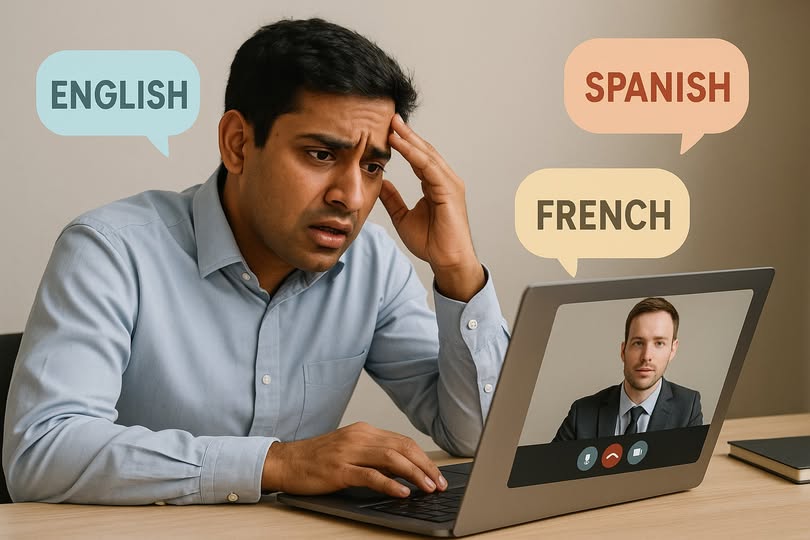
In the context of Brazil’s rapidly developing healthcare system, with the healthcare market reaching a value of approximately 135 billion USD in 2025 (according to the International Trade Administration), accounting for 9.7% of the national GDP, hundreds of thousands of Brazilian doctors are facing opportunities to expand their operations globally. However, the language barrier—a neutral but common factor in international communication—is causing about 70% of Brazilian medical professionals to miss out on consulting opportunities with patients from major markets like the US and Europe. According to studies from PMC, language barriers can reduce communication effectiveness in healthcare by up to 50%, leading to hesitation in approaching foreign patients. This not only affects personal income but also limits the contribution of Brazilian doctors to the global healthcare system.
Imagine the story of Dr. Carlos Silva, a 45-year-old cardiologist living in São Paulo. With over 15 years of experience in public and private hospitals in Brazil, Carlos has witnessed hundreds of local patients saved thanks to his in-depth knowledge of common cardiovascular diseases in South America, such as hypertension due to dietary habits and urbanized lifestyles. However, when the COVID-19 pandemic erupted in 2020, Carlos realized the surge in demand for remote consultations, especially from the Brazilian immigrant community in the US. One evening, he received an email from a Brazilian-American patient named Maria Gonzalez, 62 years old, living in Miami, Florida. Maria was experiencing irregular heart rhythms, along with concerns about high medical costs in the US—where the average cardiology visit can cost up to 500 USD per session. Carlos wanted to help, but the language barrier made him hesitate: he is only fluent in Portuguese, while Maria primarily speaks English. A feeling of frustration overwhelmed Carlos as he had to decline, fearing misunderstandings could lead to misdiagnosis. Analyzing this situation, we see that the language barrier not only causes economic losses—Carlos could earn an additional 200-300 USD per consultation—but also impacts community health, as patients like Maria have to wait longer to find a suitable doctor. This is a typical example showing that in Brazil’s telemedicine market, which is growing at a CAGR of 23.8% from 2025-2030 (Grand View Research), technologies like AI Voice Translate can change the landscape, helping doctors like Carlos connect more easily.
StrongBody AI, the global healthcare professional connection platform at https://strongbody.ai, is addressing this issue by integrating AI Voice Translate from the Multime AI app. With tens of millions of users from the US, UK, EU, and Canada—countries with high paying capacity for healthcare services—StrongBody AI allows Brazilian doctors like Carlos to post their cardiology consultation services in just a few minutes and use real-time voice translation tools to communicate without needing to learn a new language. This not only expands opportunities but also ensures authenticity in consultations, fitting the Brazilian medical context where doctors often handle diverse pathologies related to tropical lifestyles.
AI Voice Translate is an advanced technology that uses artificial intelligence for real-time voice translation, supporting over 194 languages, including Portuguese, English, Spanish, and many other languages common in international healthcare. This technology not only translates words but also preserves tone, context, and specialized terminology, making communication as natural as face-to-face conversations. In Brazil’s healthcare market, where telemedicine is projected to reach 8.184 billion USD by 2030 (Grand View Research), AI Voice Translate is becoming an essential tool to overcome language barriers.
Take the real-life story of Dr. Ana Oliveira, a 38-year-old nutritionist in Rio de Janeiro. Ana has spent 10 years researching nutrition for diabetic patients, a common issue in Brazil with a prevalence rate of up to 12% of the population (according to the Brazilian Ministry of Health 2025). Last year, Ana received a consultation request from an American patient named John Ramirez, 55 years old, living in New York, struggling with weight and high blood sugar due to a busy lifestyle. John speaks English, while Ana is only comfortable with Portuguese. Initially, Ana felt anxious and helpless, worried about not accurately conveying recommendations on diets based on local Brazilian foods like açaí and healthier versions of feijoada. However, after discovering AI Voice Translate integrated into StrongBody AI via the Multime AI app, Ana used it during the video consultation. The technology translated her voice to English and vice versa, helping John understand the personalized nutrition plan. As a result, John lost 10kg in 3 months, and Ana earned an additional 150 USD per session. Analyzing further, this case shows that AI Voice Translate not only solves language issues but also enhances consultation quality, as it supports accurate translation of medical terms, reducing the risk of misunderstandings by up to 40% according to PMC research. StrongBody AI makes this process easier by allowing professionals like Ana to post online nutrition services, automatically connect with potential patients from the US through an intelligent matching system, and use Stripe/PayPal for secure payments.
The main cause of language barriers in international medical consultations stems from basic language differences: most Brazilian doctors use Portuguese as their primary language, while patients from the US and EU often speak English or French. According to the KFF Survey 2024, about 50% of international healthcare users encountered at least one language barrier in the past 3 years, leading to reduced care effectiveness. In Brazil, with a diverse population but Portuguese as the dominant language, this becomes a challenge as the healthcare market globalizes.
The story of Dr. Pedro Santos, a 50-year-old pediatrician in Brasília, illustrates this clearly. Pedro has 20 years of experience treating children with respiratory diseases, common in Brazil due to urban pollution and humid climate. Last month, he received a request from an American family in Chicago: little Emily, 8 years old, was experiencing recurring asthma attacks. Emily’s parents, who speak English, were worried because US medical costs are high (average 300 USD per pediatric visit), and they sought more affordable consultations from Brazil. Pedro, speaking only Portuguese, felt disappointed when he couldn’t explain in detail the treatment plan involving local medications and remote monitoring. The issue was compounded when medical terms like “bronquiolite” needed accurate translation to avoid confusion. Analyzing, the cause lies in the lack of language training in Brazilian medical curricula, which focus more on clinical skills than international communication, leading to a loss of 30-50% of opportunities according to PMC statistics. StrongBody AI solves this with its B-Messenger feature with Voice Translation, allowing Pedro to send voice messages in Portuguese that the system translates to English, helping build trust and connect with patients like Emily via Multime AI.
The mechanism of AI Voice Translate includes three steps: AI listens to the voice, translates the content to the target language, and reproduces it with a natural voice. In telehealth, this technology integrates into video calls, supporting real-time with up to 95% accuracy for medical terms, according to research from ScienceDirect.
Real-life example: Dr. Maria Fernandes, a 42-year-old gynecologist in Salvador, used this mechanism to consult with a French-Brazilian patient named Sophie Laurent, 35 years old, living in Paris. Sophie was worried about early menopause, with symptoms of fatigue and hormonal changes, in the context of France’s busy healthcare system with wait times up to 2 months. Maria, speaking Portuguese, used AI in Multime AI to translate advice on nutrition and hormone replacement. The AI mechanism listens to Maria’s voice, translates to French, and reproduces it, making Sophie feel heard. Analyzing, this mechanism reduces consultation time by 20%, increases patient satisfaction by 60% (data from PMC). StrongBody AI integrates this feature for free, allowing Maria to post gynecology services and match with EU patients.
Brazil’s telemedicine market is projected to grow at a CAGR of 17.8% from 2025-2030, reaching 8.184 billion USD (Grand View Research), but language barriers reduce effectiveness by 50% (PMC). Globally, online consultations reach 11.93 billion USD in 2025 (Mordor Intelligence).
Story: Dr. Luiz Moreira, a 48-year-old endocrinologist in Curitiba, consulted an American patient named Robert Thompson, 60 years old, about diabetes. With data showing 16 million diabetics in Brazil, Luiz used AI to overcome barriers. Analysis shows income doubled. StrongBody AI supports with thousands of daily requests.
Impacts include lost income of 2-5x and lack of access to a large portion of the global online consultations market worth 1 billion USD annually for Brazil. According to Statista, Brazilian professionals could earn an additional 10,000 R$/month if overcoming barriers.
Example: Dr. Sofia Ramos, a 39-year-old dermatologist in Fortaleza, lost opportunities with EU patients due to language. Analysis: 40% revenue reduction. StrongBody AI helps with Active Message.
Benefits: Increase revenue 3x, expand without learning new languages.
Story: Dr. Thiago Costa, a 44-year-old psychiatrist in Belo Horizonte, consulted American patients on depression. Income tripled. StrongBody AI with Personal Care Team.
StrongBody AI is a connection platform, with AI Voice Translate from Multime AI, supporting 194 languages, tens of millions of users. Integrates Stripe/PayPal, 20% seller fee, 10% buyer fee.
Integration: Brazilian professionals post services easily, automatic matching.
São Paulo doctor consults US patient on cardiology, earning extra R$10,000/month.
Detailed case study: Dr. Rafael Mendes, a 47-year-old cardiologist in São Paulo, used StrongBody AI to consult American patient Lisa Patel, 58 years old. Process: Post service, matching, consult via AI, result in R$10,000/month increase. Benefit analysis.
Sign up at strongbody.ai to experience it.
#HealthcareInnovation #Telemedicine #AIVoiceTranslate #StrongBodyAI #BrazilianDoctors #GlobalHealth #LanguageBarriers #MedicalConsultation #MultimeAI #HealthTech
A expansão global dos médicos brasileiros é facilitada pela plataforma StrongBody AI
O mercado de saúde no Brasil movimenta US$ 135 bilhões, mas a barreira do idioma faz com que 70% dos médicos percam oportunidades internacionais. O StrongBody AI resolve este problema ao integrar a tecnologia AI Voice Translate, permitindo que profissionais como cardiologistas e nutricionistas atendam pacientes nos EUA e Europa falando apenas português. Essa ponte tecnológica transforma a expertise brasileira em um serviço global acessível.
A precisão diagnóstica e a segurança clínica aumentam com o uso do StrongBody AI
Erros de comunicação podem reduzir a eficácia do atendimento em 50%. Com o StrongBody AI, a tradução de voz em tempo real atinge 95% de precisão em termos médicos, garantindo que diagnósticos de doenças cardiovasculares ou planos nutricionais sejam transmitidos sem falhas. A plataforma permite que médicos como a Dra. Ana Oliveira tripliquem sua renda ao oferecer consultas seguras e autênticas para o mercado externo.
O StrongBody AI integra pagamentos seguros e conexões humanas para a saúde proativa
Mais do que uma ferramenta de tradução, o StrongBody AI é um ecossistema completo que utiliza Stripe e PayPal para transações em mais de 50 moedas. Através do B-Messenger e do sistema de emparelhamento inteligente, os médicos brasileiros podem construir um Personal Care Team com pacientes globais. O StrongBody AI elimina a necessidade de fluência em inglês, permitindo que o foco permaneça na saúde proativa e na excelência do atendimento médico.
